
Huawei is pushing a new chip design that could reduce the need for clock buffers, but experts say the technology still faces a major challenge: getting rid of heat.
Huawei is drawing attention with its LogicFolding technology, a new approach designed to make chips more compact without relying only on smaller transistors. The company says the method can shorten important connections inside a processor and reduce the number of clock buffers needed by about 50 percent. But while the design could improve efficiency in some areas, a semiconductor expert warns that heat could remain a serious problem.
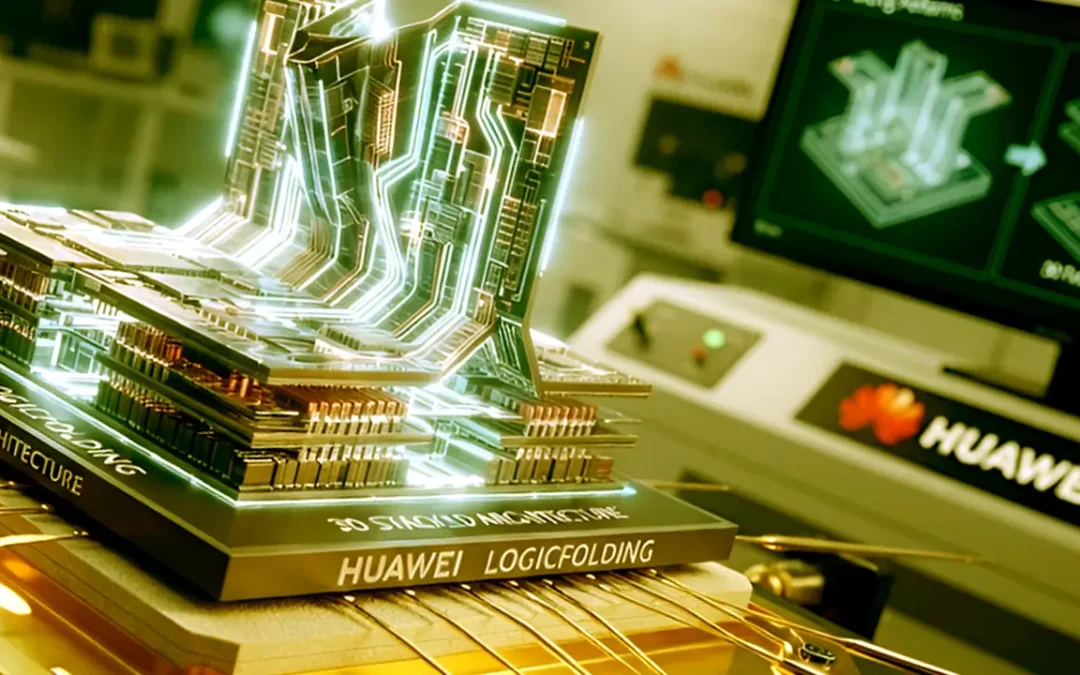
LogicFolding works by placing active layers of silicon on top of one another and connecting them with extremely small copper links. Instead of spreading circuits across a flat surface, the technology allows parts of a chip to communicate vertically. This can make better use of limited space and may increase the amount of computing power that can fit into a small area.
Recent images of Huawei’s Kirin 9050 Pro reportedly show separate compute and memory layers connected through this type of structure. The vertical connections are much shorter than many traditional connections, which can reduce the distance signals have to travel inside the chip.
Huawei says this shorter path can bring meaningful power savings. The company claims the average length of important connections can fall by around 20 percent, while some critical paths could become up to 70 percent shorter. With less distance to cover, Huawei says it can reduce clock buffers by roughly half. Fewer buffers can mean lower electrical capacitance and potentially lower power use.
However, reducing power consumption does not automatically solve every thermal problem. Semiconductor expert Taog_1575 argues that stacking active layers can make it harder for heat to escape from the chip. Even if the design lowers power use or spreads heat more effectively in some areas, the stacked structure can reduce the chip’s ability to transfer heat away.
This issue could be especially important for smartphone processors, where manufacturers have limited space for cooling. High-performance chips from Qualcomm and Apple already depend heavily on advanced manufacturing processes to improve speed and efficiency while keeping temperatures under control.
The recent discussion also sparked confusion after reports suggested Qualcomm had acquired Huawei patents. Qualcomm later said its broad patent agreement with Huawei was not connected to LogicFolding and rejected claims that it was a net payer under the deal.
LogicFolding could still give Huawei another way to improve chip performance while access to the most advanced manufacturing technology remains difficult. The biggest positive is that shorter connections could lower some power costs, while the stacked design could help fit more computing hardware into a smaller space. The main negative is that heat removal may become harder as more active silicon is placed together.
For now, LogicFolding remains an intriguing piece of chip technology with plenty of unanswered questions. If Huawei can solve the thermal challenge, its unusual approach could become more important than many expect—and the next generation of chips may reveal just how far this idea can go.